
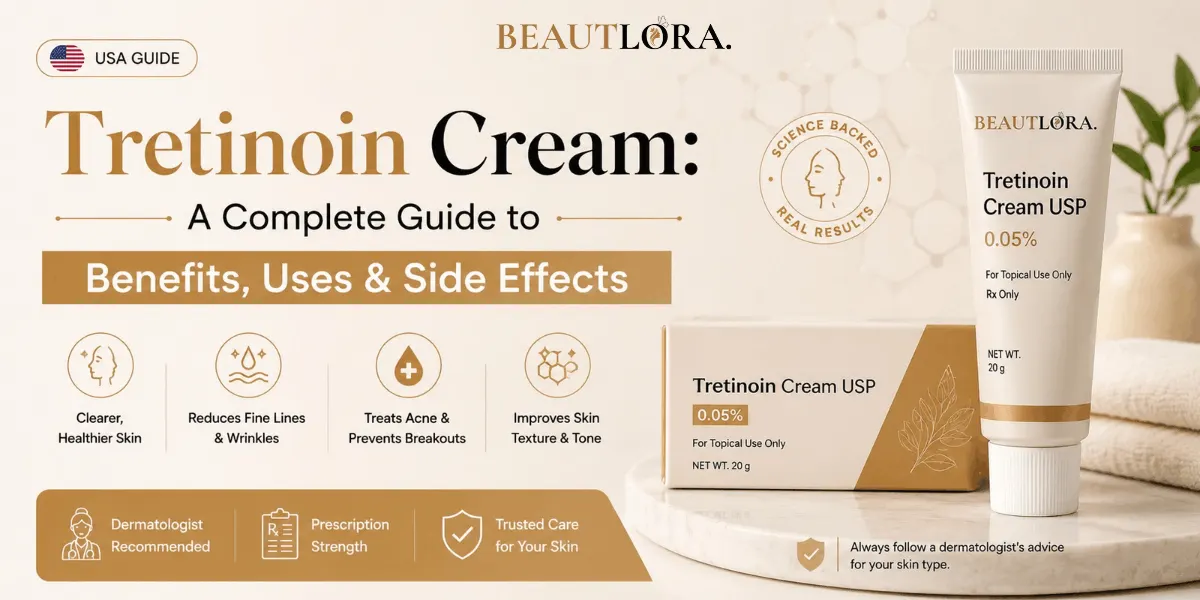
Tretinoin Cream: A Complete Guide to Benefits, Uses & Side Effects

Last reviewed: August 2026 | U.S. edition
Tretinoin has been in American medicine cabinets since 1971, which makes it older than most of the people currently discovering it on TikTok. It is the most studied topical retinoid in dermatology, the benchmark every newer product gets measured against, and — despite what the internet sometimes suggests — a prescription medication in the United States, not a skincare product.
That last point causes most of the confusion. Tretinoin sits in an odd cultural space: clinically it is a drug with a label, a set of approved indications, and real contraindications. Commercially it is marketed by telehealth companies with the aesthetic of a beauty brand. Both framings are accurate, and neither one alone gives you what you need before you start.
This guide covers what tretinoin actually is, what the FDA has approved it for, what the evidence supports off-label, how to use it without wrecking your skin barrier, the side effects worth planning for, and what it costs in the U.S. system.
Quick answer: tretinoin at a glance
- What it is: All-trans retinoic acid — the biologically active form of vitamin A. It works directly on skin cells without needing conversion.
- Prescription status: Prescription-only in the U.S. There is no over-the-counter tretinoin. (Adapalene 0.1%, a different retinoid, is available OTC as Differin.)
- FDA-approved for: Acne vulgaris (all formulations), and — for Renova specifically — mitigation of fine facial wrinkles, mottled hyperpigmentation, and tactile roughness.
- Common strengths: Cream 0.025%, 0.05%, 0.1%; gel 0.01%, 0.025%, 0.04%, 0.05%, 0.08%, 0.1%; lotion 0.05%.
- Brand names: Retin-A, Retin-A Micro, Renova, Refissa, Atralin, Altreno, Tretin-X.
- Typical use: A pea-sized amount to the entire face, once nightly.
- Realistic timeline: 8–12 weeks for acne. Six months or more for photoaging, with benefit continuing past a year.
- Main trade-off: An adjustment period of dryness, peeling, and often a temporary acne flare in weeks two through six.
- Non-negotiable: Daily broad-spectrum sunscreen. Tretinoin increases sun sensitivity, and UV exposure undoes the exact damage you are treating.
What is tretinoin?
Tretinoin is a retinoid — a class of compounds derived from vitamin A — and specifically it is all-trans retinoic acid, abbreviated ATRA. The distinction that matters is activity. Your skin cannot use vitamin A directly. Retinol, the form sold over the counter, has to be converted by enzymes in the skin: retinol becomes retinaldehyde, retinaldehyde becomes retinoic acid. Each conversion step loses potency.
Tretinoin skips the queue. It is already retinoic acid, so it binds to receptors immediately at full strength. That is why it works faster and more powerfully than retinol, and equally why it irritates more. Potency and tolerability are two ends of the same stick.
The FDA first approved topical tretinoin for acne vulgaris in 1971, following work by Albert Kligman and colleagues at the University of Pennsylvania. The anti-aging application was a genuine accident of observation — acne patients being treated long-term kept reporting that their skin looked smoother and more even, which prompted the photoaging research of the 1980s and the eventual approval of Renova.
Topical tretinoin should not be confused with oral tretinoin, sold as capsules and used in oncology to treat acute promyelocytic leukemia. Same molecule, completely different route, dose, and risk profile.
The retinoid family, ranked
|
Retinoid |
Availability |
Relative strength |
Best for |
|---|---|---|---|
|
Retinyl palmitate |
OTC |
Weakest |
Very sensitive skin, minimal effect |
|
Retinol |
OTC |
Mild |
Beginners, maintenance |
|
Retinaldehyde |
OTC |
Moderate |
A step up from retinol |
|
Adapalene 0.1% |
OTC (Differin) |
Moderate, well tolerated |
Acne, gentler than tretinoin |
|
Tretinoin |
Rx |
Strong |
Acne and photoaging, most evidence |
|
Tazarotene |
Rx |
Strongest |
Acne, psoriasis, photoaging |
|
Trifarotene |
Rx |
Strong, selective |
Facial and truncal acne |
How does tretinoin work?
Tretinoin binds to retinoic acid receptors in the nucleus of skin cells — RAR-alpha, RAR-beta and RAR-gamma. Binding changes which genes those cells express, which is why the effects are structural rather than superficial and why they take months rather than days.
Four things happen as a result:
Cell turnover accelerates. Keratinocytes move to the surface and shed faster. In the pore, that means dead cells stop accumulating into the plugs that become blackheads and whiteheads. This is the primary anti-acne mechanism, and it is preventive — tretinoin stops new comedones forming rather than treating existing pimples.
Collagen production increases. Tretinoin stimulates new collagen synthesis in the dermis and inhibits the matrix metalloproteinases that break existing collagen down. This dual action is the basis of the anti-wrinkle effect, and it is slow — histological changes take months to accumulate.
Melanin distribution normalizes. Faster turnover disperses clustered pigment, which is why sun spots and post-inflammatory hyperpigmentation fade over time.
The epidermis reorganizes. The outer layer thickens and becomes more uniform while the stratum corneum becomes more compact. A persistent myth holds that tretinoin "thins the skin." The opposite is true — the living epidermis thickens. What thins temporarily is the dead surface layer, which is why skin feels more sensitive early on.
FDA-approved uses of tretinoin
The approved label is narrower than the marketing.
1. Acne vulgaris
Every topical tretinoin formulation is approved for acne. The 2024 American Academy of Dermatology acne guidelines strongly recommend topical retinoids as first-line therapy, often combined with benzoyl peroxide or a topical antibiotic.
Tretinoin works on both types of acne lesion — the non-inflammatory comedones (blackheads, whiteheads) and the inflammatory papules and pustules. It is not a spot treatment. Applying it only to existing pimples wastes its main strength, which is stopping the *next* ones from forming.
Age approvals vary by product: Retin-A is approved from age 12, while Altreno lotion is approved from age 9.
2. Photoaging (Renova and Refissa)
Renova, a tretinoin emollient cream, is approved as an adjunct for mitigating fine facial wrinkles, mottled hyperpigmentation, and tactile roughness of facial skin — in patients using a comprehensive skin care and sun avoidance program. The label is careful about this, and so should you be: Renova does not remove wrinkles or repair sun damage, and it does not meaningfully improve deep wrinkles or the structural changes of intrinsic aging.
Note that this is an approval for fine wrinkles, as an adjunct, alongside sun protection. Everything sold as "tretinoin for anti-aging" outside the Renova and Refissa labels is technically off-label use — including most telehealth prescriptions written for wrinkles.
Off-label uses with real evidence
Off-label prescribing is legal and common in U.S. dermatology. The evidence quality varies considerably.
Melasma. Tretinoin is a component of the classic Kligman triple-combination formula with hydroquinone and a topical corticosteroid, marketed as Tri-Luma. Tretinoin alone helps melasma modestly and slowly.
Post-inflammatory hyperpigmentation. Good evidence, particularly for the marks left behind by acne. This is often the benefit patients notice first.
Androgenetic alopecia, combined with minoxidil. Tretinoin appears to increase minoxidil absorption and may improve response. Irritation on the scalp is the limiting factor.
Actinic keratosis. Tretinoin has a role in field treatment, though 5-fluorouracil and imiquimod are considerably more effective.
Keratosis pilaris. Helps some people with the rough bumps on upper arms and thighs; results are inconsistent.
Stretch marks. Modest evidence for *early, red* striae only. It does not help mature white stretch marks, and the internet consistently overstates this one.
Enlarged pores. Pore size does not truly change, but improved texture and reduced congestion make pores look smaller.
Benefits of tretinoin: what to realistically expect
Tretinoin's reputation is largely earned, but expectations need calibrating to a realistic timeline.
Clearer skin. Meaningful reduction in inflammatory and non-inflammatory lesions typically emerges at 8–12 weeks. Full clearance often takes about six months.
Smoother texture. One of the earliest and most consistently reported benefits, often noticeable around the 12-week mark.
More even tone. Sun spots and acne marks fade gradually over three to six months and continue improving with sustained use.
Fewer fine lines. The slowest benefit. Meaningful change typically requires six months minimum, with improvement continuing for a year or more of consistent use.
Better product absorption. A more uniform skin surface allows other actives to penetrate more predictably.
Prevention. Arguably the most underrated benefit. Long-term tretinoin use slows the accumulation of photodamage. The skin you protect at 30 is easier than the skin you repair at 50.
Realistic timeline
|
Timeframe |
What most people experience |
|---|---|
|
Week 1 |
Little visible change; possible tightness or mild stinging |
|
Weeks 2–6 |
The adjustment phase: dryness, flaking, redness, often an acne flare |
|
Weeks 6–8 |
Irritation settles; skin starts adapting |
|
Weeks 8–12 |
Acne improvement becomes clear; texture improves |
|
Months 3–6 |
Hyperpigmentation fades; tone evens out |
|
Months 6–12 |
Fine line improvement becomes visible |
|
Year 1+ |
Continued gradual improvement; collagen benefits accumulate |
The single biggest reason people fail with tretinoin is quitting during weeks two through six — precisely when their skin looks worst and improvement has not yet arrived.
Strengths and formulations: which one?
Cream (0.025%, 0.05%, 0.1%) is the most common choice, more hydrating and generally better for dry, mature, or sensitive skin.
Gel (0.01%–0.1%) is typically alcohol-based, dries quickly, and suits oily and acne-prone skin. It is more drying than cream at the same percentage.
Microsphere gel (Retin-A Micro, 0.04%–0.1%) uses a porous delivery system that releases tretinoin gradually, reducing peak irritation. Useful if standard formulations were intolerable.
Lotion (Altreno 0.05%) is formulated with hydrating ingredients including hyaluronic acid, designed for people who cannot tolerate cream or gel.
Emollient cream (Renova 0.02%/0.05%, Refissa 0.05%) has a richer base intended for dry, photoaged skin.
On strength: start low. For most people, 0.025% cream is the right entry point, and there is no prize for beginning at 0.1%. Higher strength does not mean faster results if the irritation forces you to stop. Dermatologists commonly recommend starting all patients with Fitzpatrick skin types IV–VI at 0.025%, because irritation in more pigmented skin carries a real risk of post-inflammatory hyperpigmentation — the exact problem you may be trying to treat.
How to use tretinoin correctly
Most tretinoin failures are application failures, not drug failures.
Use it at night. Tretinoin degrades in UV light and increases photosensitivity.
Apply to dry skin. Wash, then wait 20–30 minutes. Applying to damp skin dramatically increases absorption and irritation. This one change resolves a large share of tolerability problems.
Use a pea-sized amount for the whole face. Not per zone — total. More product does not work faster; it only irritates more.
Spread thinly and evenly. Tretinoin is preventive, so it goes everywhere acne tends to appear, not just on current breakouts.
Avoid the danger zones. Keep it away from eyes, lips, nostrils, and the creases beside the nose, where skin is thin and product pools.
Moisturize. Before, after, or both. The old belief that moisturizer "blocks" tretinoin is unfounded, and barrier support meaningfully improves adherence.
Start slow. Two or three nights a week for the first two to four weeks, then increase as tolerated. Nightly use is the goal, not the starting point.
Wear sunscreen daily. Broad-spectrum SPF 30 or higher, every morning, year-round.
The sandwich method
For sensitive skin, apply moisturizer, wait a few minutes, apply tretinoin, then apply moisturizer again. This buffers the active and reduces irritation. It slightly reduces potency — which is a fair trade if the alternative is abandoning treatment.
Don't do this
Do not apply other topical medication within an hour of tretinoin. Do not scrub, use physical exfoliants, or wash excessively. Do not apply to sunburned, windburned, chapped, or broken skin. Do not use it on eczematous skin without medical advice — tretinoin can cause severe irritation there. Do not wax any treated area; the skin will lift.
The purge: what it is and how long it lasts
The "tretinoin purge" is the most-discussed and most-misunderstood part of starting treatment.
Accelerated cell turnover pushes existing microcomedones — plugs already forming beneath the surface — to the surface faster than they would have arrived naturally. The result is a wave of breakouts that appear in weeks two through six, concentrated in areas where you normally break out.
A purge and a bad reaction look different:
|
Purging |
Adverse reaction |
|---|---|
|
In your usual breakout areas |
In new areas you don't normally break out |
|
Comedones and small papules |
Hives, welts, swelling, severe rash |
|
Peaks at weeks 2–6, then resolves |
Persists or worsens past 8 weeks |
|
Accompanied by expected dryness |
Accompanied by intense burning or pain |
Purging is normal and self-limiting. Reduce frequency rather than stopping altogether if it becomes hard to tolerate. If breakouts are appearing somewhere new, or you have significant swelling, that is not a purge — contact your prescriber.
Note also the label warning that acne may appear to worsen initially, and that more than 12 weeks may be needed before full improvement is apparent.
Tretinoin side effects
Very common (the adjustment phase)
- Dryness and flaking
- Redness
- Peeling
- Burning or stinging on application
- Itching
- Increased sun sensitivity
- Temporary worsening of acne
These typically peak in the first two to six weeks and subside as skin adapts — a process sometimes called retinization. Most resolve without stopping treatment.
Less common
- Skin tightness or a sandpapery texture
- Temporary darkening or lightening of treated skin
- Increased sensitivity to wind and cold
- Swelling
- Blistering or crusting where too much was applied
Serious — stop and seek medical advice
- Severe blistering, crusting, or open sores
- Significant swelling of the face, lips or eyes
- Hives or signs of allergic reaction
- Severe burning that does not settle
- Any reaction affecting the eyes
Systemic side effects are very unlikely, because absorption through intact skin is low. The concern with topical tretinoin is local, with one significant exception, covered next.
Tretinoin and pregnancy: getting this right
There is a great deal of confidently wrong information online about tretinoin and pregnancy, including claims about its FDA pregnancy category. Here is the accurate picture.
What the labels say. Topical tretinoin products carried Pregnancy Category C under the old labeling system. Category C meant animal studies showed some risk and adequate human studies were lacking — it did not mean the drug was proven harmful, and it did not mean it was cleared as safe. The FDA retired the letter-category system in 2015 under the Pregnancy and Lactation Labeling Rule, so any source telling you tretinoin is "Category X" today is citing a framework that no longer exists, and misciting it.
What the labels actually instruct. The Renova label states plainly that it should not be used during pregnancy. Altreno's labeling notes that there are no data in pregnant women, that systemic levels after topical use are lower than with oral tretinoin but absorption may still result in fetal exposure, and that there have been reports of major birth defects resembling those seen with oral retinoids — while noting these case reports do not establish a causal pattern.
What clinicians advise. Oral retinoids are established, potent teratogens. Topical absorption is far lower, and the epidemiological evidence for harm from topical tretinoin is weak. Nonetheless, the consistent clinical recommendation — from ACOG and from dermatology practice generally — is to avoid tretinoin during pregnancy and while trying to conceive. The benefit is cosmetic or dermatologic; the risk, however small, is to a fetus. That calculation is easy.
Breastfeeding. It is unknown whether topical tretinoin passes into breast milk. Most clinicians advise avoiding it, and at minimum keeping it well away from any area an infant might contact.
If you used it before you knew you were pregnant. Stop, and tell your OB. The realistic risk from limited topical exposure is low, and this is a conversation to have without panic.
Safer alternatives during pregnancy include azelaic acid, benzoyl peroxide, glycolic acid, and topical clindamycin — all commonly considered acceptable, though confirm with your own clinician.
What not to combine with tretinoin
Benzoyl peroxide. Historically avoided because BPO can oxidize tretinoin. Newer stabilized combination products exist, and the conflict is less absolute than once believed — but with separate products, use BPO in the morning and tretinoin at night.
AHAs and BHAs. Glycolic, lactic and salicylic acids can be layered with tretinoin, but not while your barrier is still adjusting. Wait until you are comfortably tolerating nightly use, then introduce them on alternate nights.
Vitamin C. No genuine chemical conflict, but the combined irritation is significant. Vitamin C in the morning, tretinoin at night.
Physical scrubs and cleansing brushes. Retire them. Tretinoin is already handling exfoliation.
Waxing, threading, laser and chemical peels. Most practitioners ask you to stop tretinoin for five to seven days beforehand, because treated skin lifts and blisters more readily.
Drying alcohols, astringents, and medicated soaps. These stack irritation on irritation.
Systemic drug interactions with topical tretinoin are minimal. Still, tell your prescriber if you take anything that increases photosensitivity, such as doxycycline — a common combination in acne treatment that makes sun protection even more important.
Who should be cautious with tretinoin
Discuss with a clinician before starting if you have:
- Eczema or atopic dermatitis — tretinoin can cause severe irritation on eczematous skin
- Rosacea — possible but needs a careful, slow approach
- Active sunburn — wait until fully recovered
- Very sensitive or compromised skin barrier — repair the barrier first
- A job with heavy sun exposure — feasible, but sun protection becomes critical
- Pregnancy, breastfeeding, or plans to conceive — see above
- Known sensitivity to retinoids or to fish — some formulations contain fish-derived ingredients; check the inactive list
How to get tretinoin in the U.S.
Tretinoin requires a prescription. There is no legal OTC version in the United States.
Dermatologist. The gold standard, especially for moderate to severe acne, skin of color, or complicated histories. Cash-pay visits typically run $150–$300 or more.
Primary care physician. Many PCPs comfortably prescribe tretinoin for straightforward acne, and it is usually the cheapest route if you already have a copay-covered visit.
Telehealth. Now a mainstream route. Asynchronous or video dermatology platforms prescribe tretinoin in all fifty states, typically charging $25–$75 for a consultation. State rules vary on whether audio-video is required. Legitimate platforms use licensed clinicians, ask a real history, and send the prescription to a pharmacy or fulfill through a licensed compounding pharmacy.
A warning worth taking seriously. Websites selling tretinoin with no prescription and no clinician are operating outside the U.S. regulatory system. Products may be counterfeit, mislabeled as to strength, contaminated, or degraded. Notably, no FDA-approved generic of Renova exists, so anything sold as "generic Renova" is a red flag. With a drug whose main risk is dose-related irritation, an unknown concentration is not a trivial gamble.
What tretinoin costs in the U.S.
Pricing is unusually variable — the same generic tube can differ by a factor of ten depending on how you buy it.
Generic tretinoin. Discount-card pricing has been reported as low as roughly $10–$30 for a 20g tube of 0.025% cream at large chains and warehouse pharmacies, while retail cash prices at other pharmacies commonly land in the $35–$100 range for the same product. Retail without any coupon can exceed $200.
Brand-name products. Retin-A Micro, Altreno and Renova run substantially higher — brand tretinoin cash prices have been reported in the $200–$400 range per tube. Manufacturer copay cards can reduce this for commercially insured patients, though they cannot be used with Medicare or Medicaid.
Insurance — the cosmetic problem. This trips up more people than anything else. Generic tretinoin is widely covered for acne, often at Tier 1 or Tier 2 with copays around $0–$30. Coverage for wrinkles, photoaging, or anti-aging is routinely denied as cosmetic. Plans also differ on formulation — some cover cream but not gel.
If you are being treated for acne, make sure the prescription carries the acne diagnosis code rather than a cosmetic one. If you are seeking tretinoin purely for anti-aging, budget for paying out of pocket.
Medicare. Part D coverage varies by formulary, and cosmetic indications are not covered. The Inflation Reduction Act's annual out-of-pocket cap — $2,100 in 2026 — limits total exposure for covered drugs.
HSA and FSA. Tretinoin is an eligible expense with a valid prescription. Note the IRS rule against claiming reimbursement on a purchase for which you already received a separate insurance benefit.
Compounded tretinoin. Compounding pharmacies can legally produce concentrations that no commercial product offers — 0.035% or 0.075%, for instance — or combine tretinoin with niacinamide or azelaic acid in a single formulation. This is legal under sections 503A and 503B of the Federal Food, Drug, and Cosmetic Act, provided the compound is not simply a copy of a commercially available product at the same strength and form. Compounded versions are often cheaper, around $40 a month. The trade-off is that compounded products are not FDA-approved, and quality depends heavily on the pharmacy.
How tretinoin compares to alternatives
Adapalene (Differin 0.1%, OTC). Better tolerated, available without a prescription, strong acne evidence. Weaker photoaging evidence. A sensible starting point for many people.
Tazarotene. Stronger than tretinoin, with good photoaging and psoriasis data, and correspondingly more irritating.
Trifarotene (Aklief). Selectively targets RAR-gamma and is approved for facial and truncal acne from age nine. Expensive.
Retinol (OTC). Much weaker, much gentler, no prescription needed. Reasonable for maintenance or for building tolerance before stepping up.
Azelaic acid. Good for acne, rosacea and pigmentation, and generally considered acceptable in pregnancy.
Bakuchiol. Marketed as a plant-based retinol alternative. Some small studies are encouraging; the evidence base is nowhere near tretinoin's, and it is not a retinoid.
Long-term use and stopping
Tretinoin is a long-term treatment. There is no fixed course length, and many people use it for years or decades.
Does it stop working? True tolerance is not well established. What usually happens is that irritation decreases as skin adapts, which people sometimes interpret as reduced efficacy. It is still working.
Do you need breaks? No. Continuous use is standard, and the benefits are maintained by continuing.
What if you stop? Nothing dramatic happens immediately. Acne tends to return over weeks to months, and the photoaging benefits gradually reverse as normal aging and sun exposure resume. Tretinoin maintains an improvement rather than creating a permanent one.
Seasonal adjustment. Many people reduce frequency in winter, when cold and indoor heating stress the barrier, and return to nightly use in warmer months.
Medical disclaimer
This article is for general educational purposes and is not medical advice. It does not replace consultation with a licensed healthcare provider. Tretinoin is a prescription medication in the United States and should be used only under medical supervision. Always read the prescribing information and patient package insert supplied with your medication. Individual results vary, and what is appropriate for one person's skin may not be appropriate for yours. If you experience severe blistering, swelling, or signs of an allergic reaction, stop use and seek medical attention. In an emergency, call 911.
Frequently Asked Questions
No. Tretinoin requires a prescription. Adapalene 0.1% (Differin) is the OTC retinoid alternative.
About 8–12 weeks for acne. Six months or more for fine lines, with continued improvement past a year.
Eventually, most people can. Start with two or three nights weekly and build up as your skin tolerates it.
No — a persistent myth. The living epidermis thickens and collagen increases. The dead surface layer thins temporarily, which is why skin feels more sensitive early on.
Not on the eyelids or lash line. Some clinicians permit careful application to the orbital bone area. Follow your prescriber's guidance.
Yes. Tretinoin increases sun sensitivity, and unprotected UV exposure directly undoes the photoaging benefit you are paying for.
Nothing happens. Resume the next night. Do not double up.
There is no reason to. Tretinoin is the more potent form; layering retinol adds irritation without meaningful benefit.
It helps discoloration and shallow textural irregularity. True indented scarring generally requires procedural treatment such as microneedling, lasers or subcision.
Yes, with care. Trial data in Fitzpatrick types IV–VI show improvement in mottled hyperpigmentation without worsening PIH when irritation is minimized. The key is starting at 0.025% and building slowly, because irritation itself can trigger pigmentation.
Yes. Cleanse thoroughly, let skin dry completely, and apply tretinoin at night — makeup goes on in the morning as usual.
Sophia Morgan is a health and wellness writer specializing in skin, hair, and eye health. She focuses on practical, evidence-informed guidance for everyday health and beauty concerns. Her content simplifies complex topics into clear, accessible information for readers. She is committed to promoting responsible, informed decisions about personal wellness.
Leave a comment
Please log in to join the conversation.